Palazzo
dei Cartelloni, which was the residence of Vincenzo Viviani, was the first
public monument in Florence honoring Galileo Galilei. Viviani had
affectionately assisted the Pisan scientist from October 1639 to his death in 1642. In the following
decades he expended enormous energy on the project for a monumental tomb to be
erected in honor of the Master, but was unable to overcome the resistance of
the ecclesiastical authorities, who deemed it unsuitable to honor the memory of
a man convicted of being "strongly suspected of heresy". And so it was that in
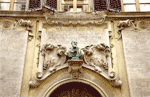
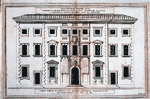
1690 Viviani commissioned his friend Giovan Battista Nelli to build the facade
of his palace, courageously intended to be a monument to Galileo. In addition
to two great scrolls bearing inscriptions hailing the Master's discoveries, he
had placed on it a bust of Galileo flanked by two bas-reliefs recalling some of
the Pisan scientist's discoveries. One of these alludes to observation, by
means of the telescope, of Jupiter's satellites to determine longitude at sea,
the other to Galileo's definition of the parabolic motion of projectiles. The
monumental tomb in the Basilica of Santa Croce, to which were moved the mortal
remains of Galileo and his faithful disciple Viviani, by now dead over thirty
years before, was inaugurated only in 1737.
In
Palazzo Viviani, today the seat of the Studio
Art Centers International (SACI) of Florence, is a lovely little garden of
classic style.
